

How AI and Technology Are Redefining Dating and Connection in the U.S. (2026-Ready Guide)
Online dating boundaries can save you time, energy, and heartbreak. This post shares 7 short sentences that hit like a bullet—so you recognize red flags early, stop chasing mixed signals, and choose self-respect fast.
😮💨 Ever feel like you’re swiping forever on a dating app—getting matches, even getting replies—but still not getting to real dates or real connection?
🔍 Here’s the secret: dating in the U.S. is moving past swipe–match–chat into a new era of AI + technology signals—think smarter personalization, voice-first vibe checks, and more inclusive communities—so you can stop wasting time on dead-end chats.
✨ What you’ll get from this guide: a clear map of what changed, how AI personalization actually works, whether AI voice tools are worth trying, how inclusive options (like disability-focused communities) fit in, and a simple safety routine for the deepfake/scam era—so you can date with confidence instead of burnout.
❓Big question: If the “rules” of dating apps are changing, what should you do differently this week to get better outcomes—without burning out?
How AI and technology are redefining dating and connection in the U.S.: What changed (and why “swipe–match–chat” is breaking)
If you’re getting matches but still feeling disconnected, this isn’t about your looks or effort—it’s about how swiping changed the rules.
Motivation line: If you’ve been blaming yourself, pause—this shift is bigger than you, and once you see it, you’ll stop wasting energy on the wrong fixes.
Swipe fatigue is not a personal failure
The swipe era trained us to believe the goal was volume: more likes, more matches, more chats. But “more” doesn’t equal “better.” In practice, a lot of people in the U.S. experience the same loop:
- Sunday night swiping → dopamine
- Monday–Wednesday chatting → polite small talk
- Thursday ghosting → frustration
- Repeat
If that’s you, you’re not alone—and you’re not “doing it wrong.” You’re interacting with a system that is historically optimized for speed and engagement, not necessarily for meaningful outcomes.
The market signal: companies are investing in “richer” connection inputs
One of the clearest recent signals is from Match Group’s Hinge. Reuters reported that Hinge founder/CEO Justin McLeod is stepping down to lead a Match Group–backed venture called Overtone, focused on AI and voice tools to enhance matchmaking. Match Group is expected to lead Overtone’s funding round in early 2026. Reuters
Translation in plain English: the industry believes the next “edge” isn’t just a prettier swipe interface. It’s deeper signals—like voice, intent, and smarter personalization.
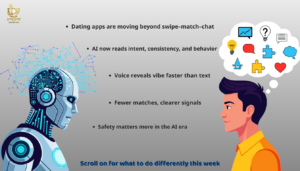
The new goal: fewer, clearer, higher-quality signals
Dating apps are increasingly trying to measure and optimize:
- Intent clarity (what someone is looking for)
- Consistency (do they show up like a real person?)
- Compatibility cues (values, lifestyle, communication style)
- Momentum (can a chat move to something real?)
You’ll feel this shift in how features are framed: prompts instead of generic bios, compatibility labels, conversation starters, voice notes, and more emphasis on safety tools.
Flow question: If apps are learning from your behavior, what is AI personalization actually “watching”—and how can you steer it?
End-of-section reward: Starting today, measure progress by quality conversations and safe dates, not by match count. That one change lowers stress and makes your choices sharper.
But if dating apps are now learning from your behavior, the real question is: what exactly is AI personalization watching—and can you control it?
How AI and technology are redefining dating and connection in the U.S.: How AI personalization works (and how to use it without getting boxed in)
Here’s the surprising part: changing just two small signals can completely change the people you see.
Motivation line: You don’t need to “beat the algorithm”—you just need to give it better signals than most people do.
What “AI personalization” usually means (no hype, just reality)
In most dating apps, “AI” isn’t a magical soulmate finder. It’s a recommendation system that ranks who you see based on patterns like:
- who you like vs. skip (and how quickly)
- what profiles you linger on
- what you message about (and whether you keep replying)
- your filters (distance, age, lifestyle)
- when you’re active and how you behave in-app
That’s why two people can use the same app and feel like they’re in totally different worlds.
Why your feed can get weird (and how to fix it)
Here’s a common real-life pattern:
- You like the most “polished” profiles—great photos, minimal text
- The app learns: “This is your type”
- It shows you more of that
- You get more matches… but chat stays surface-level
- You feel bored and blame yourself (again)
The fix isn’t to become less picky. It’s to become more intentional about what you reward with likes.
Try this 7-day experiment (simple but powerful):
- Like fewer profiles overall
- Prioritize profiles that give conversation handles (prompts, values, specifics)
- Send fewer openers, but make them more specific
If you want help reading interest signals so you stop guessing, this is a strong companion: Signals of interest in text messages
The “dating filter bubble” (and how to pop it)
Personalization can trap you in a loop: the same vibe, the same story, the same outcome. You keep meeting the “same person in different clothes.”
To break it, you need to add new data:
- engage with people who match your values even if they aren’t your default “type”
- adjust one filter that might be too rigid
- rewrite one prompt so it screens for the relationship behavior you want (not just aesthetics)
This is also where prompt-driven apps like Hinge can help, because the product design encourages more context than a photo-only swipe.
Flow question: Text gives clues—but the fastest “vibe check” often comes from voice. So what happens when dating becomes voice-first?
End-of-section reward: In under 10 minutes, add one “intent line” and one “easy reply prompt.” You’ll feel the difference in the quality of replies within days.
Text helps you screen—but chemistry often shows up faster through voice. So is voice-first dating actually worth trying?
How AI and technology are redefining dating and connection in the U.S.: AI voice tools dating experience (why voice-first is suddenly everywhere)
If you hate endless texting, a 20-second voice note can save you days of back-and-forth.
Motivation line: If you’re tired of texting for days just to learn you don’t click, voice can save you a week—sometimes more.
Why voice is becoming a major signal
The Overtone move is a big clue. Reuters described Overtone as focusing on AI and voice tools to enhance matchmaking. TechCrunch also highlighted the same shift: McLeod stepped down from Hinge to launch Overtone as an AI dating product.
Voice carries information text can’t:
- warmth vs. coldness
- curiosity vs. boredom
- pace and energy
- emotional availability (yes, you can often hear it)
How voice tools show up in real apps
Voice-first doesn’t necessarily mean long phone calls. Most people prefer lighter steps, like:
- short voice notes in chat
- voice prompts (answer a question in 15–30 seconds)
- quick “intro” recordings
Used well, it can reduce “pen-pal” situations because you learn faster whether you’re compatible.
A mini-story you’ll probably recognize
You match. You chat. It’s fine—maybe even funny. Then you meet and it feels like you’re talking to a stranger.
Now imagine you swapped one 20-second voice note on day two. You might have known right away.
Voice isn’t about replacing texting—it’s about adding one richer signal early, so you don’t invest your time in the wrong direction.
The real risks: pressure, bias, and privacy
Voice can also create new friction:
- people feel judged by their voice or accent
- shy daters feel pressured
- privacy concerns increase if you overshare early
The boundary-friendly way to do it: consent + time box.
Try: “Want to swap a super short voice note? Like 15–20 seconds—no pressure.”
If you want openers that feel natural (not rehearsed), read:
Flow question: Voice can make dating feel more human—but what about people who feel excluded or exhausted by mainstream dating app culture?
End-of-section reward: Use voice as a low-pressure vibe check: one short note, not a full call. It keeps you safe, reduces awkwardness, and speeds up clarity.
But voice isn’t comfortable for everyone—and not everyone thrives on mainstream apps. So where do inclusive and niche dating communities fit in?
How AI and technology are redefining dating and connection in the U.S.: Inclusive dating apps for people with disabilities (and why niche communities are rising)
Some people don’t need more matches—they need a space where they don’t have to explain or defend their reality.
Motivation line: If mainstream apps feel like a constant battle to be understood, niche and inclusive spaces can reduce the “emotional tax” of dating.
Why inclusive dating is growing in the U.S.
Not everyone experiences dating apps the same way. For disabled and chronically ill daters, common challenges include:
- stigma and assumptions
- having to “explain your life” repeatedly
- fear of rejection right after disclosure
- accessibility barriers and poor moderation
When the platform and community are designed around real lived needs, the experience can feel lighter and safer.
Dateability explained (what it is and why it matters)
AP recently profiled Dateability, a dating app designed for disabled and chronically ill people, founded by sisters Jacqueline and Alexa Child and inspired by Jacqueline’s own experiences. AP reported the app has around 40,000 users across the U.S., Canada, Mexico, and the U.K. AP News+1
Even if you never use Dateability, the trend matters: it signals that dating tech is moving toward community design—not just matching.
How to choose inclusive/niche apps without isolating yourself
Ask three questions:
- Do I want a larger pool, or a more relevant pool?
- Do I want clearer community norms and moderation?
- Do I need accessibility features or a disclosure-friendly space?
A small human moment (the kind that changes everything):
When you don’t have to defend your reality, you stop shrinking yourself. And once you stop shrinking, you attract people who actually fit.
Flow question: Better tech can create better connections—but it can also scale scams. So how do you protect yourself in the AI era without becoming paranoid?
End-of-section reward: Write your profile for the right person, not the most people. That one decision filters out the wrong energy early.
And as technology gets more powerful, scams get more convincing. So how do you stay safe in the AI era without becoming paranoid?
How AI and technology are redefining dating and connection in the U.S.: AI in dating safety, privacy, deepfakes and scams (your 7-point routine)
You don’t need to fear AI—you just need a clear safety routine you can repeat every time.
Motivation line: You don’t need to be fearless—you need a repeatable safety routine that gives you control.
Why safety needs an upgrade in the AI era
AI makes it easier to generate convincing messages and profiles at scale. And fraud losses are rising. The FTC reported that total fraud losses reported by older adults (60+) increased sharply from 2020 to 2024, reaching about $2.4 billion in 2024, driven in part by high-loss reports that include romance scams and impersonation. Federal Trade Commission.
Separately, FTC data also showed reported losses to fraud overall rose to $12.5 billion in 2024, with a higher share of reports involving money lost compared to 2023. Federal Trade Commission.
You don’t need to memorize numbers. The practical takeaway is this: scams are faster and more believable, so your boundaries need to be clearer, earlier.
Dating Safety & Privacy (APKAFE block)
Use this as your baseline every time you date via apps:
- Meet first in a public, busy place (coffee shop, mall). Don’t meet at someone’s home or in an isolated location.
- Tell a friend/family member your plan (time, place, who you’re meeting) and share live location when possible.
- Keep sensitive info private (verification codes, home address, financial info, ID documents, detailed routines).
- Use in-app safety tools (verification if available, block/report suspicious behavior).
- Review permissions & privacy settings (location, contacts, photos, mic). Turn on only what you need.
For a deeper beginner-friendly version tailored to U.S. first-time app users, save:
Your 7-point AI-era checklist (quick and practical)
- Keep communication in-app early on.
- Verify lightly (short voice note or short video call—consent-based).
- Watch for rush tactics (love-bombing, urgency, “move off-app now”).
- Never send money or accept “investment opportunities.”
- Limit permissions (location “while using,” avoid contact syncing if not needed).
- First date = public + you control transportation + someone knows your plan.
- If anything feels off: block/report immediately—don’t debate.
Flow question: Now that you’ve got safety handled, how do you actually use AI-era features to get results this week?
End-of-section reward: Screenshot the checklist. Having a plan reduces anxiety, and lower anxiety makes your conversations more natural.
Once safety is covered, the next challenge is momentum. So how do you actually move from chatting to real dates—this week?
How AI and technology are redefining dating and connection in the U.S.: Personalized dating apps beyond swipe match chat (a 7-day plan that creates real momentum)
One intentional week beats one intense night of swiping—because momentum comes from consistency.
Motivation line: You don’t need a total reinvention—just one good week of intentional moves.
Day 1–2: Reset your signals (so the app stops guessing wrong)
- Update two prompts: one values-based, one lifestyle-based
- Add one easy reply hook (a question that makes replying simple)
- Like less, but like smarter (reward specificity, not just aesthetics)
Outcome you’re aiming for: fewer matches, higher reply quality.
Day 3–4: Move from chat to momentum (without being pushy)
Use a three-step flow:
- specific opener
- one meaningful follow-up
- propose a tiny next step (voice note OR public coffee plan)
A sample “no-pressure” transition:
“This has been fun. If you’re comfortable, want to swap a super short voice note—like 15 seconds—just to catch a vibe?”
If you want conversation to feel natural (not like an interview), use:
Day 5–7: Measure dates, not dopamine
Track three simple metrics:
- quality conversations started
- light verification completed (voice/video)
- safe public dates planned
If ghosting is messing with your head, don’t spiral—use a framework:
Need low-pressure, budget-friendly ideas that make meeting easy?
Flow question: Before we wrap up, what are the quick questions people search right before they try AI/voice tools?
End-of-section reward: One consistent week beats one intense night of swiping. Consistency creates clarity—and clarity creates better matches.
Before we wrap up, let’s answer the questions people search right before they try AI or voice features for the first time.
How AI and technology are redefining dating and connection in the U.S.: FAQs (close variants you’re probably searching)
If you’re on the fence about using AI or voice tools, these quick answers will help you decide—without regret.
Motivation line: If you’re on the edge of trying new features, these answers will help you decide fast—without regret.
Is AI matchmaking actually better than swiping?
It can be, if you feed it better signals. AI often amplifies your behavior. If you like impulsively, it learns impulsive patterns. If you like intentionally, it learns what actually fits.
What are AI voice tools in dating—are they safe?
They can be safe when consent-based, time-boxed, and kept in-app early. Treat voice as a vibe check, not an intimacy shortcut.
Overtone AI dating startup explained: why does it matter?
Reuters reported Overtone is a Match Group–backed venture led by former Hinge CEO Justin McLeod, focused on AI and voice tools to enhance matchmaking. Reuters It matters because it signals where big investment is heading: richer signals beyond swiping.
Is Dateability only for disabled and chronically ill dating?
AP described Dateability as designed for disabled and chronically ill users to reduce stigma and make dating feel more accessible and respectful. AP News
How do I avoid deepfakes and catfish on dating apps?
Use a simple verification flow: short voice note → short video call → public first date. Keep sensitive info private. Never send money.
How do I personalize matches without giving up privacy?
Limit permissions, keep conversations in-app early, avoid oversharing contact details, and rely on clear prompts/intent rather than private data.
🎁 AI changes the tools—but your boundaries and clarity still decide your outcomes.
So with all of this in mind, what’s the real takeaway from AI-era dating?
Quick Recap + One High-Value Insight (What to Do Next)
Quick recap
Dating in the U.S. is shifting beyond swipe–match–chat:
- AI personalization shapes what you see (and you can steer it)
- voice-first tools can speed up vibe checks
- inclusive/niche communities are growing (Dateability is a strong example) AP News
- safety routines matter more as scams scale Federal Trade Commission+1
One expensive insight
Don’t ask: “Which app gets me the most matches?”
Ask: “Which app helps me create the clearest real-life signals—intent, consistency, and safety?”
That question saves time, energy, and a lot of disappointment.
CTA (next step)
Pick one dating app you trust (start with the one you already use—like Hinge if you like prompt-driven profiles), follow the 7-day plan, and measure results by quality conversations + safe public dates, not by match count.
Want to keep learning? (Internal links)
- How to Date With Standards on Dating Apps in the U.S.
- How Gen Z Is Dating in the Anti-Dating-App Era (Real Strategies That Work)
- Why he ghosted you on dating apps
- How to plan budget-friendly date ideas using dating app
Comment prompt
What’s your biggest bottleneck right now: getting replies, keeping conversations alive, or moving from chat to a safe real date?
🔚 AI is changing the tools—but your clarity, boundaries, and choices still decide the outcome.
So the better question isn’t “Which app gets me more matches?”
It’s: “Which app helps me create the clearest real-life signals—safely and consistently?”

User Reviews