

Dating App Wars 2026: Why Hinge Wins While Tinder & Bumble Reposition
Online dating in 2026 feels less exciting and more exhausting. Endless swiping, short-lived chats, and shifting intentions leave many people unsure which app actually works anymore. In this guide, we break down Hinge vs Tinder vs Bumble through what’s really changing—user behavior, AI influence, and dating priorities—so you can choose the right app, protect your energy, and move closer to real connection instead of more burnout.
Online dating in the U.S. feels different in 2026.
Not louder. Not newer. Just… heavier.
Most people between 22 and 38 have tried at least one dating app. Many have tried all three. Yet a growing number say the same thing: they feel tired. Swiping feels endless. Chats fade fast. Real connection feels rare.
This is swipe fatigue.
It happens when your mind is overloaded by too many options, too many small decisions, and too little clarity. Over time, this doesn’t just waste hours. It quietly drains confidence and motivation.
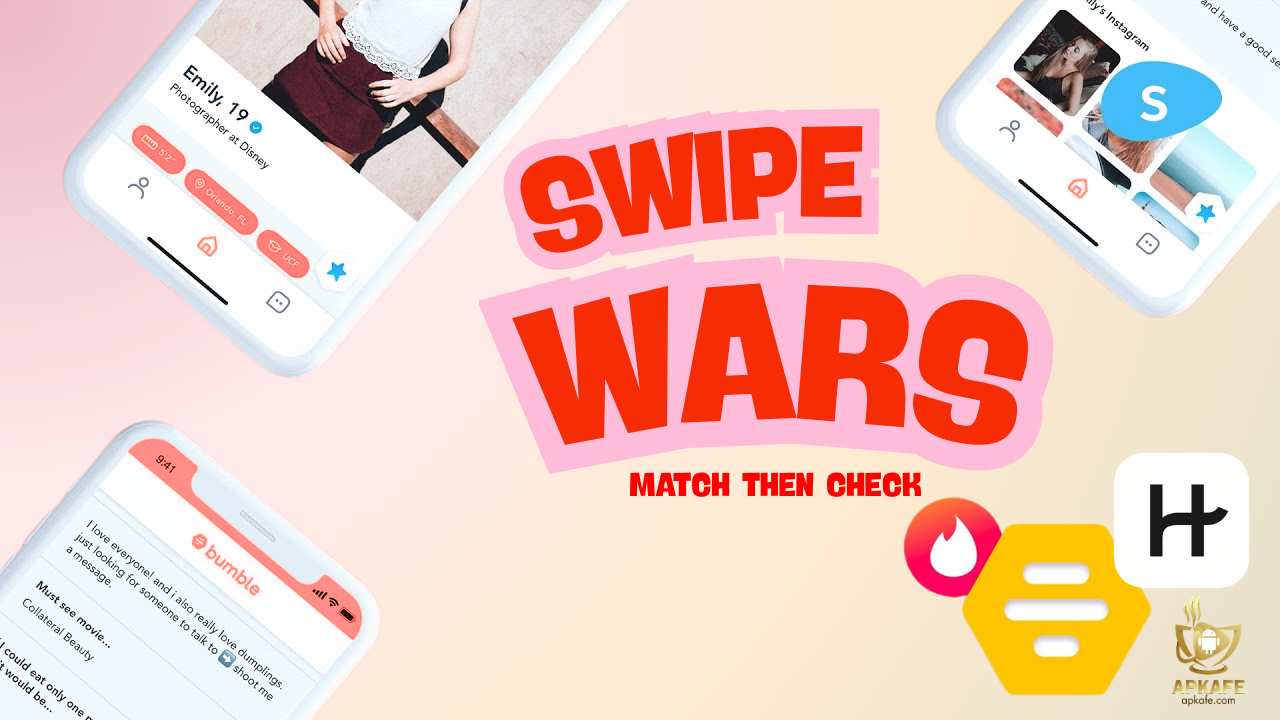
That’s why Hinge vs Tinder vs Bumble matters more than ever. These apps are not the same. They are built on very different philosophies. And in 2026, their AI systems actively reward different human behaviors.
This guide helps you choose with intention.
Not hype. Not fear. Just alignment. 🧭
A Quick 5-Minute Reset Before You Go Further ⏱️
Before comparisons, start with one simple fix.
Quick Win (5 minutes):
Open your current dating app. Remove any photo where your eyes are hidden. No sunglasses. No looking away. Direct eye contact builds trust faster than any bio line. This small change alone can improve match quality, especially when you’re trying to optimize your dating profile on Tinder or Bumble for real conversations instead of empty matches.
Small action. Real impact. ✔️
The 2026 Reality Check: Dating Apps Shape Behavior
Dating apps are no longer neutral tools.
In 2026, algorithms don’t just learn who you like.
They learn how you behave.
They track:
- How fast you swipe
- How often you open the app
- How long conversations last
- Whether chats turn into real dates
From this, apps infer your core motivation.
Are you exploring? Seeking validation? Wanting connection? Or prioritizing safety?
Then the app adapts. Quietly. Constantly.
This is why two people can use the same app and have opposite experiences. One finds steady dates. The other burns out.
To avoid the “fake road” of endless swiping, you need to understand the core essence of each platform.
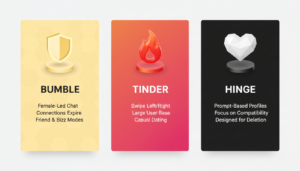
Hinge vs Tinder vs Bumble: 2026 Comparison Snapshot
| Category | Hinge | Tinder | Bumble |
|---|---|---|---|
| Core Goal | Deep connection 🤝 | Social experience ⚡ | Safety & control 🛡️ |
| Typical User | Relationship-oriented | Explorers & newcomers | Boundary-focused daters |
| Match Style | Quality over quantity | High volume & speed | Moderated interactions |
| Algorithm Bias | Conversation depth | Engagement & novelty | Behavior filtering |
| Burnout Risk | Low | High (if unstructured) | Medium |
The takeaway is simple.
The “best” app depends on where you are in life.
Hinge: Designed for People Who Want to Stop Swiping
Hinge is built around one idea: dating should lead somewhere. Its slogan, “Designed to be Deleted,” reflects a focus on bonding, not endless engagement.
A full breakdown of features, pricing, and safety can be found in this in-depth review of the Hinge dating app, which explains who it’s really for and who should skip it.
Why Hinge Feels Different in 2026
Hinge replaces numb swiping with prompt-based profiles. You don’t just like photos. You respond to opinions, habits, humor, and values.
This creates context.
And context is the foundation of real conversation.
In 2026, Hinge’s AI increasingly rewards:
- Thoughtful comments instead of mass likes
- Consistent replies instead of constant swiping
- Profiles that spark dialogue
You’re not competing on looks alone.
You’re communicating who you are.
Who Hinge Works Best For
Hinge works best if:
- You want intentional dates
- You have limited emotional energy
- You’re open to being seen, not just admired
For many gay men who want more than casual encounters, Hinge often becomes a practical place to look for a boyfriend because it filters strongly for intent.
From Quantity to Quality: A Real Shift
Take Alex, a 30-year-old professional. On high-volume apps, he had dozens of matches. Zero dates. On Hinge, he rewrote three prompts to be honest and slightly vulnerable. Two weeks later, he had fewer matches. But nearly every conversation led to a real meeting.
The difference wasn’t luck.
It was context.
Quick Win (5 minutes):
Rewrite one Hinge prompt to include a clear opinion. “I love pizza” becomes “Pineapple on pizza should be illegal.” Polarization creates a hook. It also makes it easier to start a conversation naturally on a dating app without forcing small talk.
Tinder: The High-Volume Explorer’s Playground
Tinder is still the most downloaded dating app in the U.S. Its power lies in speed, volume, and accessibility. Tinder taps into two human drives: novelty and experience.
If you want a full breakdown of how it works today, this detailed review of the Tinder dating app explains its features, safety tools, and who benefits most.
How Tinder’s Algorithm Works in 2026
Tinder’s AI is highly sensitive to behavior. It watches how fast you swipe, how often you match, and whether you follow through.
Swipe on everyone?
The app assumes you want validation or stimulation.
Be selective and consistent?
The app shows you higher-quality profiles.
This is why Tinder often feels exciting at first. And exhausting later.
Using Tinder Without Burning Out
Tinder isn’t bad. It’s powerful.
And power needs structure.
To use Tinder well:
- Swipe for 10–15 minutes a day, max
- Be selective with likes
- Move conversations toward real plans quickly
For people new to a city, Tinder offers unmatched density. But before diving in, it helps to review a dating safety checklist for first-time dating app users, especially in high-volume environments.
Used intentionally, Tinder is a tool.
Used passively, it becomes a trap.
Bumble: Safety, Boundaries, and Control
Bumble is built around a different human need: protection. Protection of time. Protection of energy. Protection of emotional safety.
A full analysis of features and safeguards is available in this complete guide to the Bumble dating app, including who it’s best for.
Why Bumble Feels More Structured
Bumble’s 24-hour match expiration discourages passive matching. Its “Opening Move” feature allows users to set a predefined question, reducing anxiety around first messages.
This structure:
- Reduces low-effort behavior
- Limits endless chatting
- Encourages clarity
The app doesn’t rush intimacy.
But it does encourage action.
Who Bumble Is Best For
Bumble works well if:
- Emotional safety matters to you
- You prefer clear boundaries
- You want balance between depth and volume
For gay men, Bumble can work. But many still compare it with the top dating apps for gay men in the US to see where community density is strongest.
Choosing the Right App: Context Is Everything 🧠
There is no universally “best” dating app.
There is only the app that fits your current context.
- Feeling mentally burned out?
Hinge’s slower pace protects energy. - New to a city like NYC or LA?
Tinder offers fast access to people, if you avoid common dating traps in the US. - Prioritizing safety and boundaries?
Bumble’s structure supports that need.
For men navigating these choices, grounded dating advice for men can help build confidence without pretending to be someone else.
From Chat to Date: A Simple 2026 Process
Most people don’t fail at matching.
They fail at transitioning.
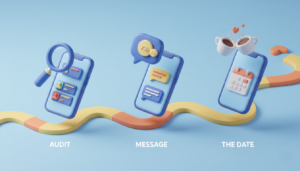
A process that still works in 2026 is the three-message rule:
- Observe: Reference something specific from their profile.
- Connect: Share a small, real detail about yourself.
- Propose: Suggest a low-pressure meet
Long chats increase anxiety.
Momentum builds attraction.
Learning to read signals of interest in text messages helps you know when it’s time to move forward. If messaging itself causes stress, learning how to fix messaging anxiety on dating apps can restore ease and confidence.
Quick Win (5 minutes):
Check your last three conversations. If you haven’t asked a genuine question recently, ask about a favorite local spot. Curiosity creates flow. 🌱
The 72-Hour Dating App Reset 🔄
If dating apps feel overwhelming, pause and reset.
Within 24 Hours
- Ask a trusted friend to pick your top three photos
- Decide your main goal this month: connection or experience
- Learn common red flags, including gay red flags on Grindr, Hinge, and Tinder, to protect your energy.
Within 72 Hours
- Send three thoughtful messages using profile context
- Practice spotting green flags you should not ignore
- Try subtle flirting to test conversational energy.
Within One Week
- Go on one low-pressure date
- Use simple, budget-friendly date ideas
- Reflect honestly. If alignment isn’t there, it’s healthy to move on and start dating again.
Final Thoughts: Stop Chasing Matches, Start Choosing Intentionally
In the comparison of Hinge vs Tinder vs Bumble, the real advantage doesn’t belong to any app. It belongs to the person who uses the app with intention.
Dating apps aren’t destinations.
They’re tools—meant to guide you toward real-life connection.
Once you understand how each platform shapes behavior, you regain control. Dating feels clearer. Lighter. More human. And whether you’re learning how to tell if a guy is gay on dating apps, navigating commitment, or simply trying to meet someone who shares your values, remember this:
Technology doesn’t decide your happiness. You do.
Choose the road that leads somewhere real.
The Invisible Factor in 2026: How AI Trains Your Dating Habits 🤖
1) Apps don’t just respond to you—they train you
One of the biggest missed truths in 2026 is this: dating apps don’t only “match” you. They also shape your habits.
Every swipe, pause, reply, and ghosted chat feeds the system. Over time, the app learns what kind of dater you are based on behavior, not your intention. That’s why people can say, “I want something serious,” and still keep getting casual or emotionally unavailable matches.
2) Habit reinforcement explains the mismatch
The mismatch isn’t always bad luck. Often, it’s pattern reinforcement.
- If you swipe late at night when you’re bored, the app learns boredom.
- If you chat endlessly without meeting, the app learns hesitation.
- If you chase unavailable people, the app learns chaos.
3) The fix is not effort—it’s predictable clarity
The solution isn’t trying harder. It’s becoming predictable in the right way.
Consistency signals clarity.
Clarity attracts better matches.
This is also why people who use Hinge intentionally often feel calmer. Meanwhile, people who drift on Tinder can feel overstimulated. Each platform amplifies the pattern you bring in.
Awareness is power here. ⚡
My Honest Advice: Date With Care, Not Pressure 🧠
1) Burnout isn’t only about apps
Dating burnout isn’t just about technology. It’s also about emotional hygiene.
Many people treat dating like entertainment. They open apps when bored, lonely, or anxious. Then they wonder why interactions feel shallow or disappointing.
2) Separate emotion from action
A healthier approach is to separate emotion from action.
Before you open an app, ask one question:
“What am I looking for right now?”
- If the answer is validation, pause.
- If the answer is curiosity or connection, proceed.
That small check-in prevents emotional leakage. It also protects self-worth.
Dating works best when it comes from fullness, not depletion. That’s why boundaries matter. It’s also why Bumble’s structure helps some people breathe easier, and why Hinge’s slower pace can feel safer during burnout.
You’re not weak for feeling tired.
You’re human.
A Simple Decision Filter You Can Use Anytime
❓Ask these three questions
When choosing between Hinge, Tinder, and Bumble, return to a simple filter. It keeps you grounded when your mood changes.
- How much emotional energy do I have right now?
- Do I want depth, experience, or safety this month?
- Am I willing to act offline if things go well?
Your answers matter more than features.
How it usually maps
- High energy + curiosity → Tinder (with limits).
- Low energy + clarity → Hinge.
- Need for safety + balance → Bumble.
And one reminder that saves people months of burnout:
You don’t need to be on all apps at once.
Being everywhere often means being nowhere.
Dating Is Not Linear — And That’s Okay
1) You’re not failing—you’re participating
Dating isn’t a straight line. You can do everything “right” and still meet people who are unavailable. You can feel hopeful one week and tired the next.
That doesn’t mean you’re failing.
It means you’re participating.
2) Real connection is built through adjustment
Real connection is built through exposure, reflection, and small course corrections. Apps can accelerate the process, but they can’t replace it.
That’s why:
- Stepping away for a week can be healthy.
- Deleting an app temporarily isn’t quitting.
- Restarting with clarity is strength, not regression.
Take a reset when you need it.
Change your mind if it’s right.
Wanting more is allowed.
Closing Reminder
In the end, Hinge vs Tinder vs Bumble isn’t a war between apps. It’s a choice about how you want to spend your time, attention, and emotional energy.
When you choose intentionally, dating stops feeling like noise.
It becomes information.
And information—used wisely—leads to connection.
Not faster.
But real.

User Reviews