



How to Date With Standards on Dating Apps in the U.S.: Screen → Lead → Build (A Modern Dating System for Women)
If Tinder/Bumble keeps giving you “almost-right” matches—great vibes, big talk, zero consistency—you’re not picky… you’re just dating without a system. Here’s the secret: a simple method (Screen → Lead → Build) turns standards into clear steps, so you stop guessing and start filtering with calm confidence. By the end, you’ll know exactly what to say, what to ignore, and how to get to safer, better dates—without sounding harsh or “interview-y.”
How to Date With Standards on Dating Apps in the U.S.: Screen → Lead → Build
⚠️ Pain Trigger: If Tinder/Bumble keeps giving you “almost-right” matches—fun banter, big words, zero consistency—you’re not picky… you’re just dating without a system.
🔑 Promise / Secret: The fix isn’t more swiping—it’s a simple process: Screen → Lead → Build, so you stop guessing and start filtering with calm confidence.
🛡️ Emotional Reward: By the end, you’ll know what to say, what to ignore, and how to get to better (safer) dates without turning into an interrogator.
Dating apps reward volume. Your heart needs standards + pace.
So instead of “Do they like me?” you’ll switch to: “Do they qualify for access?” ✅
What “standards” actually means (and what it isn’t)
If you get this definition right, you’ll waste less time immediately—because you’ll stop negotiating with your own boundaries.
Most women don’t struggle because their standards are “too high.” They struggle because their standards are too vague—so every match becomes a new emotional debate.
Standards aren’t a wishlist. They’re access rules:
- ⏳ Time access: who earns your time
- 💬 Attention access: who gets consistent replies
- 🫶 Emotional access: who you invest in
- 📍 Real-life access: who you meet
- 🔁 Repeat access: who gets the next date
Standards are NOT:
- 🚫 Control (managing someone’s choices)
- 🚫 Perfection (a “perfect partner” checklist)
- 🚫 Payback (punishing new people for old pain)
- 🚫 Chemistry’s replacement (you can still want attraction)
Standards ARE:
- ✅ A fit filter (calm compatibility sorting)
- ✅ A safety framework (privacy + boundaries)
- ✅ A pacing plan (you don’t bond before someone earns access)
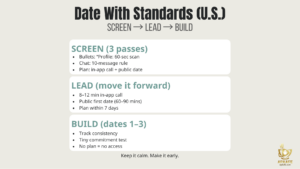
- ✅ A simple system: Screen → Lead → Build
Think of it like a modern dating funnel (human, not gross):
- SCREEN: reduce maybes fast (and safely)
- LEAD: move from chat → call → date with clarity
- BUILD: evaluate consistency after date 1–3 (so you don’t “hope” your way into regret)
Anchor question: Do you want a connection that feels exciting for 48 hours… or steady for 48 weeks?
Mini reward: if standards are access rules, you stop asking “Do they like me?” first. You start asking “Do they qualify for access?”
The 10-minute standards worksheet (non-negotiables, preferences, dealbreakers)
Do this once and you stop re-learning the same lesson with a different face every month.
Open your Notes app. Set a 10-minute timer. The goal isn’t perfection—it’s clarity you can use.
Step 1 — Choose 3 non-negotiables (must be true)
Keep these grounded and observable.
Examples:
- 🎯 Intention matches yours (casual vs serious vs “open to serious”)
- 🧭 Respectful pace (no guilt trips, no rushing intimacy)
- ✅ Consistency (can plan and follow through)
If you’re thinking “Is consistency too basic?” No—basic is rare online.
Step 2 — Choose 5 preferences (nice to have)
Preferences help you choose between good options (they’re not weapons).
Examples:
- 🏡 Lifestyle rhythm (adventures vs cozy weekends)
- 🔋 Social battery (homebody vs always-out)
- 💬 Communication cadence (daily vs a few times/week)
- 💵 Money mindset (spender/saver comfort)
- 🧩 Future/family direction (kids/marriage/timeline)
Step 3 — Write 5 deal breakers (hard no)
This protects you from “but he’s so cute…”
Common deal breakers:
- 🚩 Pushes you off-app immediately (urgent/pressuring)
- 🚩 Gets sexual after you set a boundary
- 🚩 Disappears for days then returns like nothing happened
- 🚩 Defensive at normal questions (“Why do you care?”)
- 🚩 Any money/investment/crypto talk early
If you notice you keep matching the same low-effort “almost-right” type, don’t swipe harder—tighten the signal you’re putting out with How to Optimize Your Dating Profile on Tinder or Bumble.
🎁 Mini reward: Once your standards exist on paper, you stop deciding “in the moment” (aka while emotionally hooked).
Next: how do you screen fast without becoming cynical?
SCREEN in 3 passes (Profile → Chat → Safety/Identity)
Screening is how you get your time back—and how you stop giving “maybe” people unlimited access.
You don’t need more options. You need fewer, better options. So SCREEN happens in three quick passes.
SCREEN Pass 1 — Profile screen (60 seconds)
You’re not judging someone’s worth. You’re checking fit + safety signals.
🟢 Green flags (good signs):
- 🙂 Clear face photos + real-life context
- ✍️ Bio has specifics (not just “ask me”)
- 🌤️ Positive tone
- 🎯 Clear intention (or at least honest direction)
🟡 Yellow flags (pause + verify):
- 😶 Vague bio + vague photos
- 🙄 Heavy negativity (“no drama”)
- 🧍 All group photos / unclear identity
🔴 Red flags (save your energy):
- 🔞 Immediate sexual content
- 📲 Immediate off-app push (“WhatsApp me now”)
- 💸 Money/crypto vibes
- 😡 Entitlement / disrespect
When you do match, keep your opener human and light—use a prompt from How to Start a Conversation on a Dating App so you don’t overthink the first message.
Mini reward: Pass 1 success means you only invest energy in people who look like they live in reality.
Next, Pass 2 uses the 10-message rule so you don’t bond with a stranger’s potential.
SCREEN Pass 2 — Chat screen (the 10-message rule)
Short chats protect your energy. The goal of early chat isn’t chemistry—it’s clarity.
Use the 10-message rule: within ~10 exchanges, you should know:
- Are they respectful?
- Are they consistent?
- Do intentions match yours?
- Can they plan like an adult?
3 screening questions that don’t sound like an interview:
- “What brought you to Tinder/Bumble right now?”
- “What does a good weekend look like for you?”
- “If this goes well, what are you hoping it turns into?”
You’re listening for:
- ✅ Direct answers (not evasive fluff)
- ✅ Stable vibe (not love-bomb intensity)
- ✅ Respect for pacing (no pushing)
Micro example:
- Low effort: “Just seeing what’s out there. You?”
- Better: “Dating intentionally. Not rushing, but I like consistency.”
Mini reward: Pass 2 success means you can calmly say, “Yes, I’d do a quick call with this person.”
Pass 3 is where anxiety drops—because you add safety + identity checks before any date happens.
SCREEN Pass 3 — Safety + identity screen (in-app execution)
This is where confident women become calm women.
Your standard can be simple: No call = no date.
(Not because you’re paranoid—because you value your time + safety.)
A calm, normal script (copy/paste):
“Want to do a quick 8–10 minute in-app call tonight? Easier to vibe-check before we plan.”
What you’re checking on the call:
- Can they hold a respectful conversation?
- Do answers match the profile?
- Do you feel calmer—or more anxious?
Non-negotiable safety habits:
- First meet is public, short, easy exit
- You control transportation
- No sharing codes, address, financial info, or daily routine
Before you meet anyone, save this and run it like a ritual: Dating Safety Checklist for First-Time Dating App Users (U.S.).
Mini reward: Passing SCREEN means you’re no longer hoping—you’re moving forward with eyes open.
🔁 In the next section, you will learn how to LEAD (conversation → phone call → date) without feeling pressured—and BUILD (1-3 dates) so that you value consistency, not emotional compatibility.
LEAD from chat → call → date (without feeling pushy)
LEAD is how you escape endless texting—without chasing—by giving the right person a clear path to show up.
If you don’t lead, the app leads you into dopamine loops: banter → delay → confusion → more swiping. So you’ll use a ladder that moves a good match into real-life data—fast, calm, and safe.
The Lead Ladder (simple and modern)
- Chat (10-message screen)
- Short call (8–12 minutes)
- Public first date (60–90 minutes)
- Second date only if consistency continues
You’re not “pushing.” You’re testing adult coordination. The right person won’t be scared of clarity.
🔁 Next you’ll use a date invite that sounds warm and natural—so you can move things forward without feeling needy.
Copy/paste: the 3-message date invite (warm, not needy)
Option A (soft + confident):
“Fun talking. Quick in-app call tonight? If it feels good, let’s grab coffee this weekend.”
Option B (direct + friendly):
“I’m more of an in-person person than a pen pal. Coffee or a walk on Saturday afternoon?”
Option C (boundary-forward):
“I keep first meetings simple and public—coffee for an hour. Want to pick a spot?”
If they stall or dodge planning, don’t persuade—return to the ladder:
- “Totally. If you’re up for a quick call, we can plan. If not, no worries.”
🔁 Next is the difference between calm leadership and anxious chasing: LEAD without over-investing.
Lead without over-investing (the calm rules)
Early on, keep it light:
- You’re not auditioning to be chosen
- You’re testing mutual effort
- You’re watching who can plan + follow through
- You’re not doing deep emotional labor through paragraphs
A clean rule: don’t do more emotional labor than the connection has earned.
Clarity is attractive. Over-explaining is exhausting.
If your first messages tend to feel awkward, scripted, or too intense, use How to Start a Conversation on a Dating App as your “low-pressure opener bank.” The goal isn’t perfect lines—it’s a calm start that lets SCREEN do its job.
🔁 Once the first date happens, most women confuse chemistry for meaning. BUILD is how you stay in reality.
BUILD after date 1–3 (consistency, not fantasy)
BUILD is where your standards actually protect your heart—because you evaluate patterns, not potential.
Early dating isn’t a commitment test. It’s a consistency test. Your job is to collect real-world data—then decide.
The 5-question post-date debrief (2 minutes, no drama)
After each date, ask:
- Did I feel safe and respected?
- Was there effort (planning, punctuality, follow-up)?
- Did I feel calm or anxious afterward?
- Did words and actions match?
- Do I want to see them again based on reality, not chemistry alone?
If you’re mostly “I’m not sure,” don’t force a decision. “Not sure” is data: you need one more low-pressure date, not a fantasy spiral.
🔁 Next is my favorite micro-test—one small follow-through request that reveals reliability fast.
The tiny commitment test (small follow-through = big clarity)
Ask for one normal coordination action:
- “Can you confirm by noon tomorrow?”
- “Want to choose a place for Thursday?”
- “Text when you’re on your way.”
This isn’t control. It’s adult logistics.
Consistent people don’t treat basic planning like a burden.
If you keep getting stuck “reading” texts instead of watching behavior, use Signals of Interest in Text Messages as your fast filter. It helps you stop mistaking flirting and emojis for real effort.
And if the person disappears after things feel good? It hurts—but it’s also a clean answer.
If you get ghosted or slow-faded (don’t spiral—use this response)
Ghosting feels personal, but standards turn it into clarity instead of self-blame.
Here’s your rule: no access without consistency.
If someone disappears, you don’t chase closure through paragraphs.
One-line close (calm, self-respecting):
“Seems like we’re not aligned. Wishing you well.”
Then you move on—because the system is working.
Internal-link bridge (click intent): If you want a full breakdown of why it happens (and how to recover fast without losing confidence), read Why He Ghosted You on Dating Apps—it’s built to stop the “what did I do wrong?” loop.
Safety & Privacy checklist (U.S.) + scam reality check
Safety habits don’t make you paranoid—they make you relaxed enough to actually enjoy good dates.
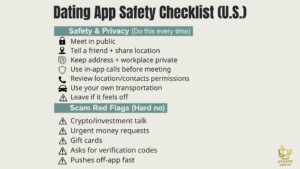
Safety & privacy checklist (simple, repeatable)
- Meet first dates in public, busy places
- Tell a friend your plan (who/where/when)
- Keep sensitive info private (codes, money, address, routine, ID photos)
- Use in-app tools (block/report) the moment something feels off
- Review app permissions (location/contacts/photos)—enable only what you need
- Use your own transportation
- Trust your instincts—you can leave early without “proof”
Save Dating Safety Checklist for First-Time Dating App Users (U.S.) and run it before every first date. You’ll feel calmer because safety becomes automatic.
🔁 Now the scam rule that should never be “flexible”—even if they seem sweet.
Scam reality check (the one standard you never relax)
If someone asks for:
- money / gift cards
- investments / crypto
- verification codes
- “urgent help”
End it immediately.
Your standards can be simple:
- No money.
- No codes.
- No urgency.
FAQs (fast, safe, Tinder/Bumble)
Quick clarity now beats overthinking tonight.
How do I do this on Tinder?
Same system:
- SCREEN: profile → 10-message chat → quick in-app call when possible
- LEAD: suggest a public first date (short, easy exit)
- BUILD: track consistency across dates 1–3
If you want a script bank for moving from chat to meet-up cleanly, use Budget-Friendly Date Ideas Using Dating Apps (public, low pressure).
How do I do this on Bumble?
Use Bumble’s in-app features first (verification/calls) and follow the same:
- SCREEN → LEAD → BUILD
If you’re unsure what to say in an early chat, pull a line from How to Start a Conversation on a Dating App and move toward the call quickly.
How can I do it fast (without rushing intimacy)?
Timebox:
- 10-message screen
- 8–12 minute call
- Plan within 7 days
Fast means less waste—not faster intimacy.
How can I do it safely?
Use the checklist above, keep first meets public, and don’t override your instincts for politeness.
If you want the reusable version you can save and follow every time, use Dating Safety Checklist for First-Time Dating App Users (U.S.).
What if I keep attracting low-effort matches?
Usually one of these is true:
- Your profile is vague (it invites vague people)
- You reward banter without plans
- You tolerate inconsistency “because he’s cute”
Fix the source signal with How to Optimize Your Dating Profile on Tinder or Bumble.
What are the best screening questions?
Try:
- “What brought you here right now?”
- “What does consistency look like to you?”
- “What are you hoping this turns into if it goes well?”
How do I stop over analyzing texts?
Replace decoding with one rule: effort > emojis.
Use Signals of Interest in Text Messages as your quick reference when your brain wants to spiral.
The Payoff — No More Guessing, Just Clear Standards
Remember the intro promise: you’d stop guessing, stop swiping harder, and learn what to say—without turning into an interrogator.
Here’s the payoff:
- You now know what to ignore (banter without plans, vagueness, urgency, off-app pressure).
- You now know what to say (short, calm scripts that move forward or close the loop).
- You now know how to get better dates through a simple truth:
Standards don’t need to be louder—they need to be earlier.
When you run Screen → Lead → Build, you stop asking “Why is he like this?”
You start asking: “Does this behavior qualify for access?”
That one shift creates calm confidence—fast.
Conclusion — Your next step (and what to click next)
Dating with standards isn’t cold. It’s clarity—early—so the right person can step in, and the wrong person exits without drama.
Pick ONE standard you’ll enforce this week. Start with the simplest: “No plan = no access.”
Then run it for 7 days and watch how fast your matches get cleaner.
Before you close this tab, choose the one link that fixes your biggest weak spot—because one wrong “next click” is how standards quietly collapse:
- Your Profile Is Quietly Repelling Good Matches — Fix These Signals Tonight
- Steal These Openers (So You Never Overthink the First Message Again)
- The First-Date Safety Ritual You’ll Use Every Single Time (U.S.)
- Ghosted? Read This Before You Blame Yourself
- The Public, Low-Pressure Date List That Filters Fast
❓What’s the ONE standard you’re enforcing first: planning, communication, safety, or pacing?

User Reviews