



How to Understand Male Psychology When Dating: 5 Principles Women Must Know Early
Understanding male psychology when dating doesn’t have to feel confusing. This guide breaks down how men think, why their behavior changes in early dating, and how to read signals with clarity. By learning the core psychological principles behind male behavior, you’ll respond with confidence, avoid emotional guesswork, and make better dating decisions from the start.
- You know that moment when a guy seems fully engaged — flirting, initiating, making you feel chosen — and then suddenly the energy drops off 😕? One day he’s sending cute good-morning texts… and the next he’s replying with a single emoji three hours later. It’s confusing, draining, and makes you question yourself more than you’d like to admit.
- But here’s the part most women never learn: his behavior isn’t random. Early-dating patterns in men follow five core psychological principles that stay surprisingly consistent across age, personality, and even dating apps. Once you understand these principles, you stop reading each message as a verdict and start seeing the bigger picture — the why behind what he does.
- By the end of this guide, you’ll know how to read his signals with clarity, respond in ways that maintain your value, and avoid investing energy in men who were never emotionally available in the first place ✨. You’ll feel calmer, more grounded, and more confident navigating early dating — whether it’s on Tinder, Bumble, or in person.
👉 Maybe you’ve been in a situationship where he showed affection but avoided defining anything.
👉 Or maybe you met someone great who went from “I really like you” to “I’ve just been busy” overnight.
What if these weren’t “red flags” — but psychological patterns you simply haven’t been shown how to interpret?
Keep reading — the answers you’ve been missing are just below 👇.
The 5 Core Principles of Male Psychology When Dating (And How They Affect You)
✨ Master these five principles and you’ll understand 80% of male behavior — without overthinking, over-texting, or dissecting screenshots with your friends.
Before diving in, one distinction matters:
Men aren’t emotionally shallow — they’re emotionally structured.
Because many were never encouraged to verbalize feelings the way women often are, interest and hesitation show up more through actions, pacing, and consistency than long emotional conversations.
Understanding that difference alone saves you weeks of confusion and unnecessary anxiety.
Principle #1 — The Hero Instinct: Connection Grows When He Feels Helpful
One of the strongest motivational forces in men — especially early on — is the desire to feel they contribute something meaningful. This isn’t about “saving” anyone. It’s about feeling involved.
📌 Real-life moment:
You casually mention choosing between two outfits for a date, and his face brightens while offering an opinion. Not because he believes he’s a stylist — but because inclusion strengthens the bond.
Small gestures like checking the weather, suggesting a great café, or walking you out after dinner aren’t trivial. They’re connection cues.
Typical signs of the Hero Instinct:
- Confidence increases when genuine appreciation is expressed
- A quiet emotional drop occurs if contributions feel dismissed
- Initiative rises when his presence clearly improves your experience
How to activate this instinct naturally:
Invitations work beautifully:
- “Which place matches our Saturday vibe best? I like your taste 😊.”
- “I’m torn between these two photos — which one feels most like me?”
These aren’t games. They’re ways of letting him participate — a dynamic that often strengthens his emotional investment. You can amplify this effect by polishing your dating profile (APKAFE’s guide is helpful here):
👉How to Optimize Your Dating Profile on Tinder or Bumble
❌ Pitfall: exaggerated praise becomes performative.
☑️ Pro Tip: appreciate the action, not the identity.
“Thanks for the suggestion — that made deciding way easier.”
🔁 But when someone doesn’t step into this role confidently — when hesitation appears instead — Principle #2 reveals why.
Principle #2 — Fear of Rejection: More Caution Than You Expect
Despite stereotypes, many men feel vulnerable in early dating. Rejection doesn’t just sting — it undermines their sense of competence, which makes emotional pacing cautious.
📌 A familiar moment:
A typed paragraph is deleted… rewritten… deleted again… before a simple:
“Hey 😅 what are you up to?”
Not low interest — just fear of being too forward.
Behaviors shaped by rejection anxiety:
- Texting rhythm fluctuates to avoid appearing overly invested
- The emotional tone on your end shapes how he engages
- Labels are avoided early; he fears wanting more than the other person
- A vulnerable moment may be followed by a brief reset period
These subtle shifts become easier to read once you understand common interest signals via text:
How to respond without pressure:
- Stay warm, not instantly available
- Match interest, not intensity
- Use messages like:
“Text me when you’re free — I’d like to keep this going 😊.”
It’s open, calm, and reassuring.
❌ Pitfall: filling every silence with over-explaining.
☑️ Pro Tip: allow him the experience of pursuing — not just responding.
🔁 If fear shapes his pacing, why do some men test reactions instead of sharing feelings directly? That’s where Principle #3 begins…
Principle #3 — Subtle Testing: Reactions Reveal More Than Words
✨Many “mixed signals” aren’t mind games — they’re quiet compatibility checks.
Subtle shifts in tone, tempo, or boundaries often act as emotional sensors. Instead of asking directly, men observe how someone responds to small moments because reactions offer clearer insight than explanations.
📌 Common subtle tests:
- A slower texting rhythm gauges whether insecurity spikes or calmness holds
- A minor vulnerability is shared to sense emotional safety
- A soft boundary is floated to see if it’s respected
- A playful question tests communication style and warmth
Understanding these shifts becomes easier when your own tone stays grounded. Smooth openers and balanced messaging—like those in APKAFE’s guide to starting natural conversations—help keep the dynamic stable.
How to navigate subtle tests smoothly:
Light, confident responses signal emotional steadiness.
A gentle, “Hope your day’s been treating you well 😊,” carries more strength than over-explaining or seeking reassurance.
❌ Pitfall: reacting as though every change in tempo means danger.
☑️ Pro Tip: respond to overall patterns, not isolated moments.
🔁 Once subtle testing settles, the next dynamic usually appears: the need for space — which brings us to Principle #4.
Principle #4 — The Need for Space: Emotional Processing, Not Disinterest
✨ When the connection feels intense, a brief pause can happen — not as retreat, but as recalibration.
Emotional overload, even after positive moments, often triggers a quiet reset period. Meaningful dates, deeper disclosures, or a rapid increase in intimacy may create an internal need for breathing room.
📌 Signs a reset is happening:
- Replies come slower while tone stays warm
- Initiative dips but engagement remains
- Interaction feels steady but quieter
- Mental bandwidth seems full rather than avoidant
Interpreting these signals is far easier when you understand normal texting patterns, which are explained clearly in APKAFE’s guide on signals of interest via text.
Maintaining gentle warmth during this phase preserves connection. A soft note like, “Hope the week gives you a little space to recharge 😊,” respects boundaries while still showing presence.
Dating apps can sometimes intensify pacing too quickly due to algorithm-driven matches, leading to emotional overstimulation. APKAFE’s guide on how dating app algorithms suggest matches helps explain why some connections escalate faster than expected.
Healthy pauses don’t require anxious chasing. They simply call for steadiness.
❌ Pitfall: assuming distance equals rejection.
☑️ Pro Tip: warmth + autonomy = emotional safety.
🔁 Once space has been honored, genuine connection often re-emerges through consistent actions rather than emotional declarations — exactly what Principle #5 explains.
Principle #5 — Actions Are the Primary Language of Interest
✨Behavior reveals commitment more clearly than words ever could.
Instead of lengthy emotional conversations, deeper interest shows up as thoughtful consistency. Effort, planning, and reliability often communicate what many men find difficult to verbalize.
📌 Meaningful action-based signals:
- Plans made ahead of time rather than spontaneous last-minute meetups
- Schedules adjusted to create time together
- Details remembered and referenced later
- Small problem-solving gestures when life feels stressful
- Steady check-ins even on busy days
When these behaviors appear, the emotional investment is real.
Building on this energy works best through authentic appreciation. “That was really thoughtful of you 😊,” is simple yet effective. This approach aligns naturally with finding matches who share your intentions—especially if you’re exploring the best dating apps for serious or aligned connections.
❌ Pitfall: overlooking consistent effort while waiting for verbal confirmations.
☑️ Pro Tip: if behavior aligns with interest, spoken clarity usually follows at the right pace.
🔁 Once action-based affection is understood, the next question becomes inevitable: why does someone still pull away at times — even when interest is real? That connects directly to the “Why Men Pull Away” section.
Away” section.
Why Men Pull Away — 4 Psychology-Based Reasons
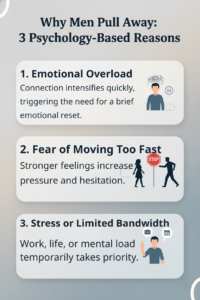
✨ Pullback usually reflects internal pacing, not fading attraction.
Emotional shifts can feel confusing, especially when connection seems strong. Yet most distancing behaviors stem from internal processing rather than disinterest. Recognizing the patterns behind withdrawal helps you respond calmly instead of spiraling.
1) Emotional Pacing Mismatch
A connection that moves quickly for one person may feel too fast for another. When emotional acceleration outpaces comfort, a pause often follows.
Supportive response: mirror the slower pace while keeping warmth steady.
🔁 If pacing isn’t the issue, internal fear often plays a role…
2) Fear of Premature Commitment
Growing attraction raises the emotional stakes. Instead of stepping closer, some men slow down to avoid being the first person fully invested.
Supportive response: avoid pressure; allow the relationship to unfold at an organic pace.
🔁 But emotional pressure isn’t the only culprit—outside stress matters too…
3) Stress or Limited Bandwidth
Work, money, family dynamics, and daily overwhelm often compete with emotional availability. Many compartmentalize, which means dating temporarily shifts to the background.
Supportive response: offer understanding without turning into a fixer.
🔁 And finally, the one reason most women worry about—but shouldn’t take personally…
4) Uncertainty About Compatibility
Not all hesitation signals rejection. Some individuals step back briefly to evaluate emotional fit and long-term potential. It’s a reflection, not dismissal.
Supportive response: stay consistent, grounded, and self-contained.
For stronger clarity during confusing texting phases, APKAFE’s guide to signals of interest via text helps you interpret shifts more accurately.
❌ Pitfall: assuming pullback means the connection is ending.
☑️ Pro Tip: calm consistency is often what stabilizes the dynamic.
🔁 Once withdrawal is understood, the next challenge is knowing exactly how to respond — which brings us to the next H2.
Response Scripts for Real Dating Scenarios
✨ The right message can shift the tone instantly — without pressure or over-giving.
Clear, grounded communication makes early dating smoother for both sides. These short scripts maintain warmth while reinforcing your emotional standard.
When texting becomes inconsistent:
“Let’s touch base when things settle on your side 😊.”
When initiation slows down:
“I enjoy our conversations — message whenever you’ve got space.”
When space is requested:
“No worries. Take the time you need.”
When interest is real but overwhelm appears:
“No rush — keeping things light feels good to me.”
When you need to set a boundary:
“I’m here for something consistent. Let’s keep things honest and simple.”
For crafting smoother conversations (especially on dating apps), APKAFE’s guide on natural openers is helpful: 6 Ways to Start Natural Conversations on Dating Apps.
❌ Pitfall: explaining feelings in paragraphs rather than one grounded sentence.
☑️ Pro Tip: clarity lands better when delivered lightly.
🔁 Scripts solve the immediate moment — but understanding the bigger picture requires a framework. That’s what comes next.
The 5-Step Framework for Understanding What a Man Really Wants
✨ This system eliminates guesswork and keeps you grounded, no matter the situation.
A simple structure helps decode intentions with clarity. Instead of reacting emotionally to every shift, the framework gives you a calm lens for interpreting the relationship.
Step 1: Watch patterns for 7–10 days
Single moments mislead; consistency reveals truth.
Step 2: Compare words with behavior
Alignment between effort and language matters more than speed or intensity.
Step 3: Evaluate pacing compatibility
Emotional rhythms must align. Too fast or too slow creates anxiety on either side.
Step 4: Communicate lightly and intentionally
Short, grounded statements outperform long emotional explanations.
Step 5: Set boundaries early
Boundaries maintain connection quality and prevent resentment.
You can also understand why some matches accelerate faster due to app algorithms in APKAFE’s breakdown of how dating app algorithms suggest matches.
❌ Pitfall: reacting to uncertainty rather than interpreting patterns.
☑️ Pro Tip: a calm framework naturally reveals whether a match is worth deeper investment.
🔁 Once these steps are in place, confidence follows — leading naturally into your takeaway or conclusion section.
🌟 The Reward — The Moment Everything Finally Makes Sense
You’ve moved through the core psychological principles, the real reasons men pull away, and the scripts that shift the dynamic instantly.
Now comes the unlock moment — the payoff promised from the very beginning.
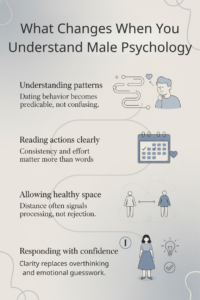
✨ Once the psychology becomes clear, his behavior stops feeling personal.
Most of the stress — the waiting, the overthinking, the emoji interpretation, the screenshot debates with friends — didn’t come from misunderstanding him.
It came from not having a framework to decode what was happening.
📌 With this clarity, certain truths become obvious:
- Effort reveals attraction far more than long messages
- Pullback is often a reset, not rejection
- Hesitation tends to come from fear, not disinterest
- Testing reflects curiosity about compatibility, not manipulation
- Intention appears in patterns, not promises
If you want to sharpen your ability to read these behavioral signals, especially through texting subtleties, explore this guide on signals of interest via text . It pairs perfectly with what you’ve just learned.
Dating stops feeling chaotic. It becomes steady, grounded, and intuitive — a process where you hold the lens, the clarity, and the advantage.
💬 Here’s the real transformation:
The internal question shifts from “What did I do wrong?”
to
“Does this behavior align with the kind of connection I want?”
Strength rises from that shift.
Calm settles in with it.
Clarity becomes the reward.
Conclusion — Your New Dating Advantage
✨ Clarity becomes your superpower the moment male psychology stops feeling mysterious.
Conversations get lighter, pressure disappears, and emotional investment naturally gravitates toward people who show real effort.
A grounded presence does more than attract healthy partners — it filters out misaligned ones without you having to push.
If you’re looking for your next step, these resources extend everything you’ve learned here:
And anytime you’re unsure how to respond to a specific message or situation, feel free to ask.
I can decode it instantly — with clarity, nuance, and calm.

User Reviews